
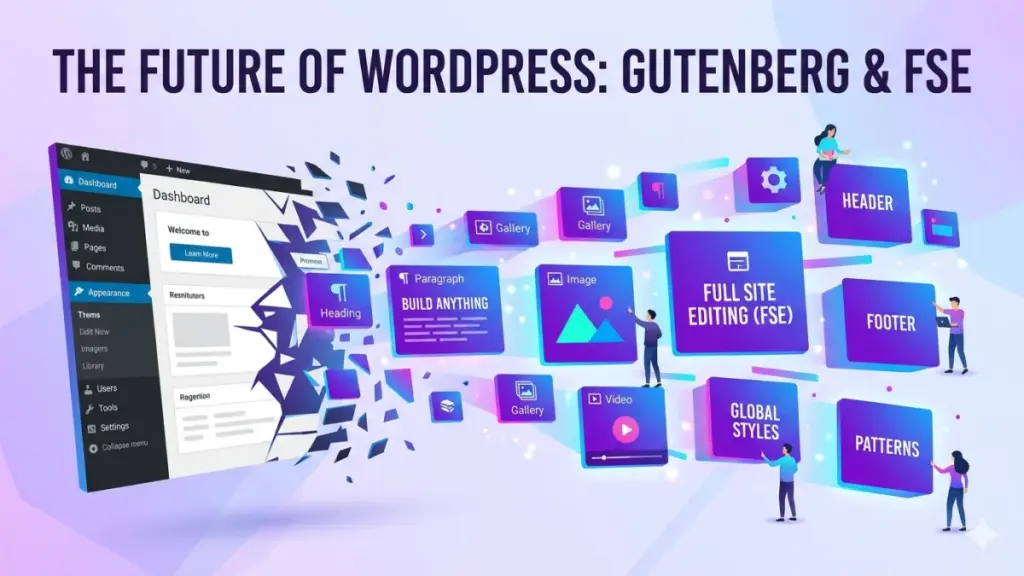
WordPress is in the middle of the most significant transformation in its history. The shift from the Classic Editor to Gutenberg was just the beginning. Now, Full Site Editing, block-based themes, and a radically new approach to building websites are reshaping what WordPress can do.
Whether you are a developer, designer, or site owner, understanding where WordPress is headed will help you make better decisions today. Here is what the future looks like.
The Gutenberg Revolution
When Gutenberg launched with WordPress 5.0 in December 2018, it was controversial. The block-based editing paradigm replaced a single rich text area with discrete, movable blocks for paragraphs, images, headings, and more. Early versions were rough. But four years and dozens of releases later, Gutenberg has matured into a genuinely capable content editor.
Today, Gutenberg blocks handle everything from columns and media embeds to custom query loops and dynamic content. The block library grows with every release, and third-party block plugins extend it further. The era of the TinyMCE toolbar is firmly behind us.
Full Site Editing Changes Everything
Full Site Editing (FSE) extends the block model beyond post content to the entire site layout. Headers, footers, sidebars, templates, and template parts all become editable blocks. This means you can visually build your entire site — not just your pages — without touching code.
FSE is enabled through block themes, which use HTML-based templates instead of PHP template files. The Site Editor, accessed from the WordPress admin, provides a visual interface for editing templates and global styles. It is the closest WordPress has come to a true visual site builder.
The Classic Approach Is Not Going Away
Despite the momentum behind FSE, classic PHP-based themes are not deprecated and will not be anytime soon. The WordPress project has explicitly committed to maintaining backward compatibility. Millions of existing sites run on classic themes, and many developers prefer the control and predictability of PHP templates.
At WPForge, we believe in a hybrid approach. PHP templates provide pixel-perfect structural control that block templates cannot yet match. Gutenberg inside the_content gives clients an intuitive editing experience. This is the sweet spot between developer control and user empowerment.
Blocks Are Becoming the Universal Format
WordPress is pushing toward a future where blocks are not just for content — they are the universal format for everything. Navigation menus become block-based. Widget areas become block-based. Customizer sections migrate to the Site Editor. The long-term vision is a unified, block-based interface for every aspect of site management.
This has implications for plugin developers, too. Widget-based plugins will need to offer block equivalents. Shortcode-based plugins should consider block transformations. The plugin ecosystem is adapting, slowly but steadily.
Performance Is a Core Priority
The WordPress performance team has made significant strides. Automatic WebP generation, lazy loading by default, and improvements to the script loading API are now in core. The proposed Performance Lab plugin incubates experimental features like speculative loading and dominant color image placeholders.
The goal is ambitious: make a default WordPress installation achieve passing Core Web Vitals scores on average hosting. If achieved, this would be transformative for the platform market share and user experience.
Collaboration and Real-Time Editing
One of the most ambitious projects under development is real-time collaboration. Imagine Google Docs-style simultaneous editing inside the WordPress block editor. Multiple authors working on the same post, seeing each other is changes in real time. This is being built as Phase 3 of the Gutenberg roadmap and represents a fundamental shift in how teams use WordPress.
Multilingual Is Coming to Core
WordPress has long relied on third-party plugins for multilingual functionality. That is changing. Phase 4 of the Gutenberg roadmap includes native multilingual support. While still in early planning, this would make WordPress a first-class multilingual CMS without plugins. The implications for global adoption are enormous.
AI Integration
Artificial intelligence is making its way into WordPress. AI-powered block helpers for content generation, image alt-text suggestions, and readability improvements are appearing in plugins. Core discussions are ongoing about how to integrate AI responsibly. Expect AI-assisted content creation and optimization to become standard features within the next few years.
What This Means for You
If you are building a new site today, you do not need to wait for the future. Classic themes remain a solid, reliable choice. Block themes offer exciting new possibilities but are still maturing. The key is to stay informed, experiment with new tools, and make technology choices that serve your specific goals — not trends.
Conclusion
WordPress in 2026 is more powerful, more flexible, and more ambitious than ever. The block paradigm is reshaping everything from content editing to site building. Performance, collaboration, multilingual support, and AI are on the horizon. The future is bright, and the tools keep getting better. Whether you embrace FSE today or prefer the classic approach, WordPress continues to be the most versatile platform for building on the web.
0 Comments
Please log in to leave a comment.